All posts by fiscroll

How to Choose a Crypto Exchange

Cryptocurrency has quickly moved from a niche tech trend to a mainstream investment option. If you’re thinking about diving in, one of the first and most important decisions you’ll make is choosing the right crypto exchange. Think of a crypto exchange like your digital bank or stockbroker—it’s where you go to buy, sell, and sometimes store your digital assets. But with so many exchanges out there, picking the right one can feel overwhelming, especially if you’re new to the world of crypto.

In this beginner-friendly guide, we’ll walk you through the most important things to consider before signing up and investing your money.

Security Comes First

The digital nature of cryptocurrencies makes security a top priority. A good exchange should have strong protection in place to guard your funds. Look for platforms that offer two-factor authentication, which adds an extra layer of protection beyond just a password. Reputable exchanges usually store most of their users’ assets in cold storage—offline and safe from hackers. Some also offer insurance for user funds in case of a breach. Before committing to any exchange, it’s wise to research its track record. If it has a history of being hacked or receiving regulatory warnings, it’s probably best to steer clear.

Be Aware of Fees

Crypto exchanges make money by charging fees—but how and how much they charge can vary greatly. You’ll typically pay a small percentage when you buy or sell, but there may also be charges when depositing or withdrawing funds. Some platforms might also sneak in less obvious costs, like unfavorable exchange rates or extra charges for using credit cards. Even small differences in fees can add up over time, so take the time to compare a few options and make sure you’re not paying more than necessary.

Liquidity Makes a Big Difference

Liquidity refers to how easily you can buy or sell your crypto without affecting the market price. The higher the liquidity, the smoother your trading experience will be. On a highly liquid exchange, there are enough buyers and sellers to ensure you can execute trades quickly and at fair prices. This is especially important if you plan to invest larger amounts or trade frequently. Low-liquidity exchanges can lead to delayed transactions or getting less value for your money.

Check Which Coins Are Offered

Not all exchanges offer the same range of cryptocurrencies. While almost every platform supports major coins like Bitcoin and Ethereum, you might need to dig deeper if you’re interested in newer or lesser-known coins. Before registering, browse the exchange’s list of supported assets to make sure it includes the cryptocurrencies you’re interested in. Some platforms specialize in a wide variety of altcoins, while others stick to the most popular options.

Ease of Use Matters

If you’re new to crypto, choosing an exchange with a clean and simple interface can make your experience much more enjoyable. Some platforms are designed for experienced traders, filled with complex charts and technical tools. Others focus on beginners, offering an easy way to buy and sell crypto in just a few steps. Many exchanges also have mobile apps, which is great if you want to manage your investments on the go. A user-friendly platform makes learning and investing less intimidating.

Think About Local Currency and Payment Options

Before choosing an exchange, check whether it accepts your local currency. Some platforms only deal in U.S. dollars or stablecoins, which means you might need to convert your money first—potentially paying extra fees in the process. Also, look at the available payment methods. Can you fund your account with a bank transfer, credit card, or a service like PayPal? Some options are faster than others, and the fees can vary depending on the method you choose.

Know Where It’s Available

Regulations can limit which exchanges are available in different countries. Just because an exchange is popular globally doesn’t mean it’s allowed to operate where you live. Make sure the platform is accessible and legally compliant in your country. Some exchanges even offer localized customer support or support for your native language, which can be a big plus if you ever need help.

Customer Support Can Save the Day

At some point, you might run into a problem—whether it’s a delayed transaction or a login issue. That’s when customer support becomes critical. Choose an exchange known for responsive and helpful service. Check if they offer live chat, email support, or a comprehensive help center. Reading reviews from other users can give you a good idea of how seriously they take customer service.

Reputation and Transparency Are Crucial

In the world of crypto, reputation is everything. Take a little time to research the exchange you’re considering. Is it run by a well-known company? Is the leadership transparent about their team and location? Avoid platforms that keep everything vague or that have been involved in controversies. Checking forums like Reddit or review sites like Trustpilot can help you get honest feedback from other users.

Look for Extra Features

Some exchanges go beyond just buying and selling. You might find features like crypto staking, which lets you earn interest on certain coins just by holding them. Others offer recurring investment options, where you can automatically buy a fixed amount each month—great for building your portfolio over time. Tax reporting tools can also be helpful, especially if you’re making lots of trades. These extra tools can make managing your investments easier and more rewarding.

Withdrawals to Non-Custodial Wallets Are Important

One of the core principles of cryptocurrency is control—being your own bank. But that only happens when you move your crypto from the exchange into a non-custodial wallet, where you hold the private keys. Some exchanges make it easy to withdraw your assets, while others limit withdrawals, charge high fees, or even lock funds temporarily.

If you want full control over your crypto, choose an exchange that allows fast, low-fee withdrawals to wallets like MetaMask, Trust Wallet, or hardware wallets such as Ledger and Trezor. This is especially important if you’re investing for the long term or want to participate in DeFi, staking, or NFT platforms that require self-custody.

Remember the saying in crypto: “Not your keys, not your coins.” Always make sure your exchange supports easy withdrawals so you can truly own what you buy.

Final Thoughts

Getting started with cryptocurrency can be exciting—but also confusing if you don’t have the right tools. Choosing a good exchange is the first step toward a safe and successful investment journey. Look for one that’s secure, easy to use, transparent, and available in your country. Make sure it supports the coins you want and offers fair fees for the services you need.

By taking the time to choose carefully now, you’ll set yourself up for a smoother experience later. And remember: start small, invest wisely, and never risk more than you’re willing to lose.

How Crypto Wallets Work

In the world of cryptocurrency, ownership and control of digital assets depend entirely on how you manage and store your cryptographic keys. At the heart of every crypto wallet are four core components: private keys, public keys, wallet addresses, and recovery phrases (also known as seed phrases or mnemonic phrases). Understanding how these pieces work together is essential to managing your crypto securely.

What Is a Crypto Wallet?

A crypto wallet is not a place where coins are physically stored. Instead, it’s a tool that lets you interact with blockchain networks by managing the keys that prove ownership of your digital assets.

There are two main types of crypto wallets:

  • Custodial Wallets: Managed by third parties (like exchanges), where your private keys are held on your behalf. Convenient, but you’re trusting someone else with your funds.
  • Non-Custodial Wallets: You hold and manage your own keys, giving you full control—and full responsibility—over your assets.

These can further be divided into:

  • Hot Wallets: Connected to the internet. Ideal for frequent transactions but more exposed to online threats.
  • Cold Wallets: Stored offline. Greatly reduces the risk of hacks and is preferred for long-term storage.

The Core Elements of Every Crypto Wallet

No matter the type, every crypto wallet relies on a few fundamental components:

  • Private key – for sending funds
  • Public key – for verifying transactions
  • Wallet address – for receiving funds
  • Seed phrase – for backing everything up

Private Key

Every crypto wallet is built around a private key. When you create a new wallet, the system automatically generates one for you.It’s a long string of letters and numbers.

Example: 5Kb8kLf9zgWQnogidDA76MzPL6TsZZY36hWXMssSzNydYXYB9KF

This key allows you to sign transactions and prove you own the funds in the wallet. If someone else gains access to your private key, they can spend your crypto. Losing your private key means losing access to your funds—permanently.

When you send funds, your wallet uses the private key to digitally sign the transaction, proving you own the assets being moved. This signature is verified by the network using your public key—without ever exposing the private key itself.

In software wallets (like mobile or desktop apps), private keys are encrypted and stored locally on your device. In hardware wallets, keys stay safely inside the device and never touch the internet.

Public Key

Your public key is mathematically derived from your private key. It’s safe to share and is used by the blockchain to verify transactions signed by your private key.

While the public key allows anyone to verify transactions and send you funds, only the private key allows you to spend or transfer those funds. Importantly, while the public key can be mathematically derived from the private key, the reverse is practically impossible due to cryptographic design.

Public keys are also stored in your wallet, but since they don’t grant access to your funds, there’s no harm in exposing them. While you don’t often use the public key directly, it’s important to understand that it acts as a link between your private key and your wallet address. The public key is used to create your wallet address, which is what you give out to receive crypto.

Wallet Address

Your wallet address is the part most people interact with. It’s what you give someone when they want to send you crypto. It tells the blockchain where to send crypto. Anyone can view transactions to and from this address (blockchains are public!), but no one can access the funds without the private key.

When someone sends you crypto, they’re sending it to this address. But remember, only you (with your private key) can actually move that crypto once it arrives.

Seed Phrase

Since private keys are complex and difficult to memorize, wallets generate a seed phrase—a human-readable backup of your private key(s), usually made up of 12 or 24 random words.

Example:
window carpet lava planet coffee smile lava whale exile gym giggle lobster

Seed phrase can regenerate all private keys associated with your wallet. If your device is lost, damaged, or reset, you can restore your wallet on any device to restore full access to your funds. 

Anyone with your seed phrase can access your wallet, so keep it safe, offline, and never share it. Never store it in your email, cloud storage, or messaging apps.

Single-Key vs. Multi-Key Wallets

Wallets can be configured with different key structures:

  • Single-Key Wallets: Use one private key to manage one or more addresses. Common in personal wallets like MetaMask or Trust Wallet. Simple and user-friendly.
  • Multi-Key Wallets: Some wallets are Hierarchical Deterministic (HD), allowing many key pairs to be derived from a single seed phrase. Others are multi-signature (multisig) wallets, requiring multiple private keys to approve a transaction—ideal for shared accounts or increased security.

How It All Works Together in a Transaction

Let’s look at a typical flow of events in a crypto transaction:

1. You Create a Wallet

  • Your wallet generates a private key.
  • A public key is created from your private key.
  • A wallet address is created from the public key.
  • A seed phrase is generated to back it all up.

If you’re using an HD wallet, multiple addresses and key pairs can be managed under one seed.

2. Someone Sends You Crypto

  • You give them your wallet address.
  • They send crypto to that address.
  • The transaction is recorded on the blockchain.
  • Only your private key can unlock or move the funds.

3. You Want to Send Crypto

  • You open your wallet app and choose the amount to send.
  • The app uses your private key to sign the transaction (this proves it’s really you).
  • The network checks your public key to confirm the transaction is valid.
  • The crypto is sent and the transaction is recorded on the blockchain.

Final Thoughts

When people say they “own cryptocurrency,” what they really mean is that they control the private key linked to that cryptocurrency on the blockchain. The blockchain records all transactions publicly, so anyone can verify ownership using the public key. However, only the holder of the private key can authorize spending.

Lose your private key or seed phrase, and you lose access to your crypto—permanently. There’s no recovery service or password reset. That’s why secure management of your wallet information is absolutely critical in crypto.

In Summary

  • Private Key: Automatically generated when you create a wallet. It’s stored securely in the wallet and used to sign transactions. You don’t interact with it directly.
  • Public Key: Derived from the private key. Used to verify your transactions and generate your wallet address.
  • Wallet Address: Shared with others to receive funds. Functions as your “account number” in the crypto space.
  • Recovery Phrase: A human-readable backup of your private key(s). Stored safely to recover access to your wallet if needed.

Understanding how private keys, public keys, and seed phrases work is critical for anyone involved in crypto.  With the right knowledge, you’ll be well on your way to becoming a confident and secure crypto investor.

 Learn before you send — mistakes in crypto can be permanent

Reference:

https://www.investopedia.com/terms/p/private-key.asp

 https://blocktrade.com/wallet-addresses-public-and-private-keys-explained

https://www.gemini.com/cryptopedia/public-private-keys-cryptography

https://trustwallet.com/blog/security/private-key-vs-recovery-phrase

Understanding Cryptocurrency Wallets

If you’re new to crypto investing, one of the first things you’ll come across—after hearing about Bitcoin or Ethereum—is the concept of cryptocurrency wallets. But what are they, exactly? And why are they important?

In this beginner-friendly guide, we’ll explain everything in plain language so you can understand what crypto wallets are and how they work.

What Is a Cryptocurrency Wallet?

If you’re getting started with crypto, one of the first things you’ll need is a cryptocurrency wallet. This is a tool that lets you store, send, and receive digital money like Bitcoin, Ethereum, and other cryptocurrencies.

But here’s something important to understand:

A crypto wallet doesn’t actually hold your coins. Instead, it stores something called your private keys—these are like super-secure passwords that give you access to your crypto.

According to Investopedia, “Cryptocurrencies are not “stored” anywhere—they are bits of data in a database, scattered all over it; the wallet finds all of the bits associated with your public address and sums up the amount for you in the app’s interface.”

Each wallet has:

  • A public address – kind of like your email address, which you share with others so they can send you crypto.
  • A private key – this is what you use to access your funds and approve transactions. Keep this private! 

If someone gets access to your private key, they can take your crypto.

The private key can be stored either by a wallet provider (in a custodial wallet) or directly by the user (in a non-custodial wallet).

  • Custodial wallets: In custodial wallets, the wallet provider holds and manages the private key on behalf of the user.
  • Non-custodial wallets: In contrast, non-custodial wallets give users full control, meaning only they can access and manage their private keys.

Types of Cryptocurrency Wallets

Wallets can be Hot or cold depending on whether they are connected to the internet or not. 

Hot Wallets (Connected to the Internet)

Hot wallets are cryptocurrency wallets that stay connected to the internet, which makes them very easy to use for everyday transactions and trading. Because they’re always online, they’re great for people who actively buy, sell, or move their crypto around. Some popular hot wallets include mobile apps like Trust Wallet and MetaMask, web-based wallets like Coinbase and Binance, and desktop apps like Exodus.

The main advantage of hot wallets is convenience—you can access your crypto quickly whenever you need it. However, the downside is that being online all the time also makes them more vulnerable to hacking, phishing scams, and other cyber threats.

Cold Wallets (Offline Storage)

Cold wallets, in contrast, are kept offline, which makes them much safer from online attacks. These are ideal if you’re planning to invest in crypto for the long term and don’t need to access your funds often. Common examples include hardware wallets like Ledger and Trezor, which are physical devices that store your private keys securely, and paper wallets, where your keys are written or printed and stored somewhere safe.

While cold wallets offer much stronger protection against hackers, they’re less convenient for quick transactions. There’s also a risk of losing access to your crypto if the device or paper is misplaced or damaged without a backup.

Wrapping Up

Cryptocurrency wallets are the foundation of your crypto journey. Whether you’re trading daily or holding for the long haul, choosing the right wallet—and understanding how it works—can make or break your investing experience.

The key is simple: Protect your private keys and pick a wallet that fits your needs. With the right wallet, you’ll be well on your way to investing in crypto with confidence.

Check out the following links for more details on Cryptowallets.

  1. https://blocktrade.com/how-to-choose-the-best-crypto-wallet
  2. https://www.investopedia.com/terms/b/bitcoin-wallet.asp


Coins vs Tokens: What’s the Difference in Crypto?

If you’re just getting started with cryptocurrency, you’ve probably seen the words “coin” and “token” thrown around. They sound similar – and yes, both are types of digital assets – but they’re not the same thing.

Let’s us try to understand the difference.

What Is a Coin?

A coin is a type of cryptocurrency that runs on its own independent blockchain. That means the technology behind it (the blockchain) is built from the ground up, and the coin is the native currency of that system.

Common Characteristics of Coins:

  • Have their own blockchain (like Bitcoin has the Bitcoin blockchain, Ethereum has the Ethereum blockchain).
  • Used mostly for payments, transaction fees, or storing value.
  • Function like digital money — you can send them from one person to another.

Examples:

  • Bitcoin (BTC) – Used mainly as a store of value and digital cash.
  • Ethereum (ETH) – Used to pay for transactions on the Ethereum network.
  • Litecoin (LTC) – A faster, lighter version of Bitcoin.
  • So, if it’s powering its own network, it’s a coin.

What Is a Token?

A token is a cryptocurrency that runs on top of an existing blockchain (usually Ethereum, but also others like Binance Smart Chain, Solana, etc.).

It doesn’t have its own blockchain — it uses someone else’s. Tokens are often used in specific applications, like games, finance apps (DeFi), or even as company shares (security tokens).

Common Characteristics of Tokens:

  • Created using smart contracts on another blockchain (e.g., Ethereum).
  • Used for specific purposes like rewards, access to services, voting in a project, or as in-game currency.
  • Easier and faster to create than coins, because you don’t need to build your own blockchain.

Examples:

  • Uniswap (UNI) – A token for a decentralized exchange on Ethereum.
  • Chainlink (LINK) – Powers data feeds for smart contracts.
  • USDT (Tether) – A stablecoin token on Ethereum, pegged to the U.S. dollar.

So, if it’s built on another blockchain, it’s a token.

Simple Analogy:

Imagine a blockchain as a country:

  • A coin is like the official currency of that country.

  • A token is like a gift card or metro pass that works inside that city for special services.

Why Should You Care?

When you invest in a coin, you’re often buying into a core part of a blockchain – like digital gold or a new kind of internet money.

When you invest in a token, you’re usually supporting a project or app built on top of an existing blockchain. Tokens can grow fast if the project succeeds – but they can also be riskier.

Knowing the difference helps you:

  • Understand what you’re investing in
  • Spot the potential (and the risks)
  • Make smarter, more confident choices

If you’re an investor:

  • Coins are more established and often less risky (like BTC, ETH).

  • Tokens can offer bigger rewards — but also higher risk — as they’re tied to specific projects or apps.

Final Thoughts

While both coins and tokens are integral to the crypto ecosystem, they serve different roles. Coins act as the foundation of blockchain networks, while tokens leverage existing networks to offer diverse functionalities. As you explore investment opportunities in cryptocurrency, being able to distinguish between the two will help you better assess the purpose, potential, and risk of different digital assets.

India in the News: Words That Defined the UPA and NDA Years

When we look back at India’s recent history, political leaders and major events often take center stage. But what if we told you that a simple analysis of news headlines over time can reveal powerful insights into what the nation was truly focused on?

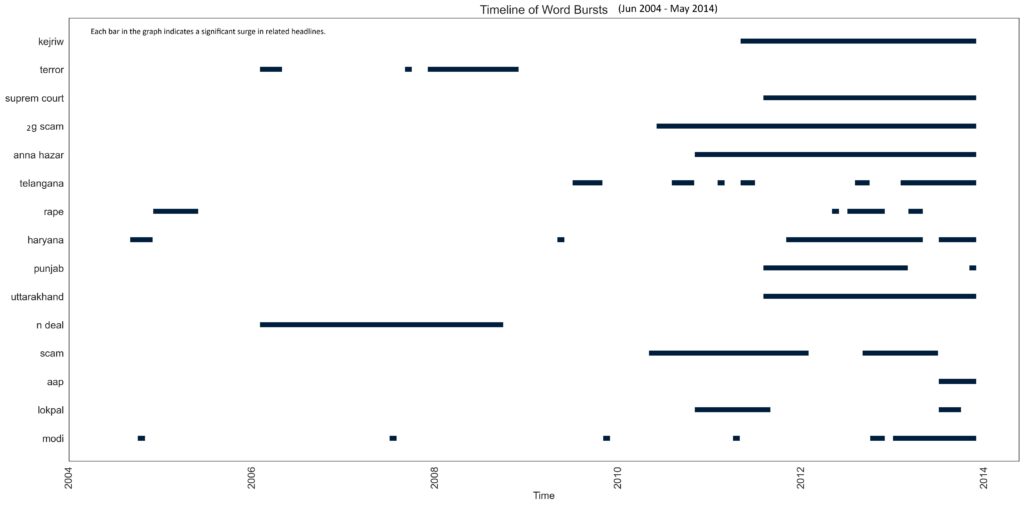
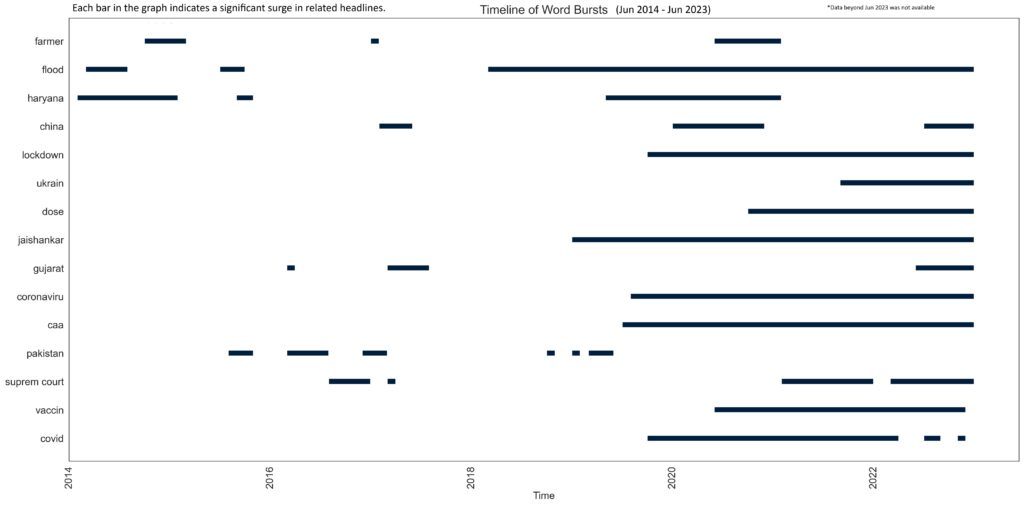
We recently did a burst analysis of news headlines from June 2004 to June 2023—spanning the UPA  rule from 2004 to 2014 and the NDA  rule from 2014 to 2023. 

Don’t worry if you haven’t heard of the term “burst analysis” before. In simple terms, it just means identifying words that suddenly appeared a lot more frequently than usual during certain periods. It’s a way of spotting trends in public discourse.

Where the Data Comes From

The data for this analysis was collected from a Kaggle.com (data science platform). It includes headlines between June 2004 and June 2023, from top Indian publication. Data beyond June 2023 was not available.

What Grabbed Headlines During the UPA Rule (2004–2014)

The UPA government led by Dr. Manmohan Singh saw some major national and international developments. Here are some of the top terms that dominated headlines during this period:

  • Nuclear Deal (2006–2009): India’s civil nuclear agreement with the United States sparked a political storm and dominated news for several years.
  • Anna Hazare & Kejriwal (2011 onwards): The anti-corruption movement launched by Anna Hazare and Arvind Kejriwal caught the nation’s attention like wildfire. It led to the birth of the Aam Aadmi Party.
  • 2G Scam: This major telecom scandal remained in the news through the later UPA years.
  • Aam Aadmi Party & Narendra Modi (2013–2014): As the 2014 elections approached, Arvind Kejriwal’s party and Narendra Modi became frequent mentions in headlines.

This period was marked by political turmoil, civil activism, and scandals, shaping the nation’s mood and media focus.

Buzzwords from the NDA Rule (2014–2023)

As the NDA government took over under Prime Minister Narendra Modi, the news cycle took a sharp turn towards other pressing concerns:

  • Flood (2018 onwards): Natural disasters, especially floods in various parts of the country, were frequently in the headlines.
  • Lockdown, Coronavirus, COVID, Vaccine (2020 onwards): Like the rest of the world, India’s attention sharply turned to the pandemic. These terms surged in frequency and dominated public discourse.
  • CAA (Citizenship Amendment Act): This became a focal point of national debate and protests around 2019–2020.

These years were shaped by public health crises, environmental challenges, and major policy debates.

What Does This All Mean?

When we step back and look at the big picture, it’s clear that different issues dominated the national consciousness at different times:

  • UPA years were filled with policy negotiations, anti-corruption movements, and political transitions.
  • NDA years were marked by crises (natural and medical), nationalistic policies, and global health emergencies.

It’s a reminder that the issues we care about most aren’t just shaped by politicians—they’re shaped by circumstances, movements, and moments that grip the country.

Disclaimer:

This analysis is based on public headline data available on Kaggle.com and reflects trends observed from that dataset. The accuracy and completeness of the dataset cannot be independently verified, and the analysis should be seen as indicative, not definitive.

Market Capitalization Rate vs. Cost of Equity

[latexpage]

Market capitalization rate and the cost of equity are not the same, although they are related concepts in finance. While they both deal with investments, they serve different purposes and contexts. Let’s break them down in simple terms.

Market Capitalization Rate

In the context of the capital markets, the market capitalization rate refers to the expected return on an investment based on its current market value. It’s often used by investors to evaluate the profitability of stocks or portfolios.

It can be expressed as the sum of dividend yield and growth rate, g \[ r = \frac{Dividend_1}{P_0} + g \]

The formula for calculating the market capitalization rate is:

\[ \text{Market Cap Rate} = \frac{\text{Expected Dividends} + \text{Capital Gains}}{\text{Current Market Price}} \]

– Expected Dividends: These are the payments expected to be received from the investment.
– Capital Gains: The anticipated increase in the stock’s price over time.
– Current Market Price: The price at which the stock is currently trading.

Cost of Equity?

The cost of equity is the return that investors expect for holding a company’s equity (i.e., its stocks). It represents the compensation that investors require for the risk they take by investing in the company.

One common method to calculate the cost of equity is the Capital Asset Pricing Model (CAPM):

\[ \text{Cost of Equity} = \text{Risk-Free Rate} + \beta \times (\text{Market Return} – \text{Risk-Free Rate}) \]

– Risk-Free Rate: The return on a risk-free investment, usually government bonds.
– Beta: A measure of the stock’s volatility compared to the overall market.
– Market Return: The expected return of the overall market.

Cost of equity for a firm should not be taken as its personal property. Rather, it should be reflective of the cost of equity of all the firms in same risk class.

Key Differences

  • Purpose:
    • Market Cap Rate: Used to evaluate the expected return on an investment based on its market value, primarily for stocks.
    • Cost of Equity: Represents the return that investors expect from holding a company’s equity, reflecting the risk involved.
  • Context:
    • Market Cap Rate: Commonly discussed in the capital markets for individual stocks or portfolios.
    • Cost of Equity: Often used by companies for financial decision-making, such as evaluating new projects.
  • Calculation:
    • Market Cap Rate: Focuses on dividends and capital gains relative to current market price.
    • Cost of Equity: Considers risk-free rates, market return, and stock volatility.

Conclusion

In summary, while both the market capitalization rate and cost of equity relate to investment returns, they apply to different scenarios and have different implications. Understanding these concepts can enhance your investment strategy, whether you’re assessing stocks or evaluating company performance. Keep learning, and happy investing!

Simple Constant Growth Discounted Cash Flow (DCF) for Market Capitalization Rate

[latexpage]

Using the Simple Constant Growth DCF to Assess Market Capitalization Rate

Valuing a company accurately is crucial for making informed investment decisions, and among the various methods available, the Discounted Cash Flow (DCF) model stands out as a fundamental approach. One of its simpler yet effective variants is the Simple Constant Growth DCF model. This model, also known as the Gordon Growth Model or the Dividend Discount Model (DDM), provides insights into how to determine a company’s market capitalization rate. Let’s explore how this model works and what it means for assessing market value.

What is the Simple Constant Growth DCF Model?

The Simple Constant Growth DCF model is designed to value a company’s stock by assuming a perpetual, constant growth rate in dividends or free cash flows. It’s a straightforward method that hinges on a few key assumptions but offers powerful insights into a company’s value.

Understanding the Basics

In this model, dividends are treated as a perpetuity, meaning they continue indefinitely. The present value of this perpetuity, with a discount rate \( r \) and a growth rate \( g \), can be calculated using the formula:

\[ \text{Present Value} = \frac{\text{Year 1 Cash Flow}}{r – g} \]

For equity, cash flow is equivalent to dividends. Thus, the present value of all future dividend streams can be expressed as:

\[ P_0 = \frac{D_0 \times (1 + g)}{r – g} \]

where:
– \( P_0 \) = Current stock price (or value of the company)
– \( D_0 \) = Dividend just paid
– \( g \) = Constant growth rate of dividends (or free cash flows)
– \( r \) = Required rate of return (market capitalization rate)

To find the market capitalization rate \( r \), rearrange the formula:

\[ r = \frac{D_0 \times (1 + g)}{P_0} + g \]

Estimating the Growth Rate \( g \)

Estimating the growth rate \( g \) is crucial for applying the Simple Constant Growth DCF model effectively. This growth rate can be derived from various sources:

1. Historical Growth Rates:
– Analyze past dividend or earnings growth to project future growth rates.

2. Future Projections:
– Utilize projections from financial analysts or company forecasts.

3. Plowback Ratio and ROE:
– The plowback ratio represents the percentage of earnings reinvested in the business after paying dividends. It is calculated as:
\[ \text{Plowback Ratio} = 1 – \frac{\text{DIV}}{\text{EPS}} \]
– Return on Equity (ROE) is the ratio of earnings to book value. Growth rate can be expressed as:
\[ g = \text{Plowback Ratio} \times \text{ROE} \]
This formula links dividend growth to the company’s reinvestment strategy and profitability.

Implications and Limitations

While the Simple Constant Growth DCF model is valuable, it comes with limitations:

1. Assumption of Constant Growth:
– The model assumes a perpetual, constant growth rate, which may not be realistic for all companies, especially high-growth or volatile stocks.

2. Sensitivity to Inputs:
– Small variations in the growth rate or current stock price can significantly affect the calculated market capitalization rate.

3. Suitability:
– This model works best for companies with stable and predictable dividend policies. It might not be suitable for companies in highly volatile industries or those that do not pay dividends.

4. Market Capitalization Rate Across Stocks:
– It’s often useful to compute the market capitalization rate for a group of similar stocks and take the average to mitigate individual stock anomalies.

Conclusion

The Simple Constant Growth DCF model provides a clear framework for estimating a company’s market capitalization rate, making it an essential tool for investors. By understanding its assumptions and limitations, you can use this model effectively to gauge a company’s value and make more informed investment decisions. Remember, while this model offers a valuable perspective, it should be complemented with other valuation methods for a comprehensive analysis.

Landscape of India’s Oil and Gas Sector

India, the world’s third-largest consumer of oil and gas, has a dynamic and evolving oil and gas sector that is integral to its economy. As of 2023, India consumed 222.3 million metric tonnes (MMT) of petroleum products, with crude oil production standing at 29.16 MMT. Assam, Gujarat, and Rajasthan are the major oil-producing states, contributing over 96% of the country’s output. India’s extensive crude pipeline network spans 10,941 kilometers with a capacity of 153.1 million metric tonnes per annum (MMTPA). The country has 23 refineries, with a combined capacity of 256.8 MMTPA, making it the second-largest refiner in Asia.

Market Size and Segments

The Indian oil and gas market is estimated to be 38.12 billion cubic meters in 2024 and is projected to grow to 49.12 billion cubic meters by 2029, at a compound annual growth rate (CAGR) of 5.20%. The market is segmented into upstream, midstream, and downstream sectors. The upstream segment involves exploration and production, the midstream segment focuses on transportation, and the downstream segment covers refining and distribution. The refining sector is particularly significant, with private companies holding about 35% of the total refining capacity.

Growth Drivers

Several factors are driving growth in India’s oil and gas sector:

  1. Increasing Energy Demand: India’s energy demand is expected to grow faster than any other major economy, driven by robust economic expansion and rising urbanization.
  2. Government Investments: The Indian government plans to invest ₹7.5 lakh crore (approximately USD 102.49 billion) in oil and gas infrastructure over the next five years.
  3. Strategic Petroleum Reserves: India aims to commercialize 50% of its Strategic Petroleum Reserves (SPR) to fund additional storage facilities.
  4. Rising Natural Gas Consumption: Natural gas consumption is expected to grow at a CAGR of 12.2% by 2030, driven by expanding infrastructure and favorable policies.

Challenges

Despite the growth prospects, India’s oil and gas sector faces significant challenges:

  1. High Import Dependency: India imports over 80% of its crude oil and nearly 40% of its natural gas, making the economy vulnerable to global price fluctuations.
  2. Environmental Concerns: The sector faces increasing pressure to reduce carbon emissions, particularly with the global shift towards renewable energy sources.
  3. Infrastructure Bottlenecks: Although the government is investing heavily, infrastructure limitations, particularly in pipeline networks, continue to hinder sectoral efficiency.
  4. Regulatory Hurdles: Complex regulatory frameworks and delays in project approvals can slow down investments and growth in the sector.

Market Players

The Indian oil and gas market is fragmented, with key players including Oil and Natural Gas Corporation (ONGC), Oil India Limited (OIL), Reliance Industries, Indian Oil Corporation Limited (IOCL), and Punj Lloyd Limited, among others

  1. Oil and Natural Gas Corporation (ONGC): A leading public sector company involved in exploration and production.
  2. Indian Oil Corporation Limited (IOCL): The largest domestic refiner, with a capacity of 70.1 MMTPA.
  3. Reliance Industries: A major player in both upstream and downstream segments.
  4. Oil India Limited (OIL): A key player in exploration and production.
  5. Punj Lloyd Limited: An important player in the infrastructure and engineering services for the oil and gas sector.

Key Trends

Several trends are shaping the future of India’s oil and gas sector:

  1. Refining Capacity Expansion: India plans to double its refining capacity to 450–500 million tonnes by 2030.
  2. Pipeline Expansion: The pipeline network is expected to grow significantly, with the government investing USD 9.97 billion in gas pipeline expansion.
  3. LNG Infrastructure Development: The setting up of LNG stations across the country is expected to bolster natural gas usage.
  4. Adoption of Euro VI Standards: State refineries have upgraded their facilities to comply with Euro VI emission standards, reflecting a move towards cleaner fuel.

Conclusion

India’s oil and gas sector is a vital component of its economy, with strong growth potential driven by increasing energy demand and significant government investments. However, challenges such as high import dependency and environmental concerns need to be addressed. With key players actively expanding their capacities and the government’s focus on infrastructure development, the future of India’s oil and gas sector looks promising.